If you are working out how to design an exhibition stand for a show in Barcelona or Madrid while your team sits in another country, the challenge is not only creative. You need a design that works for your brand, complies with the rules of a Spanish venue and can be built, shipped and assembled without you being on site for every decision.
At Factoría Creativa we have been in exhibition stand design and assembly for more than 20 years and have worked at more than 500 trade fairs. Below we walk you through the process we follow with every client, phase by phase: what happens, what you receive and where projects usually go wrong.
The exhibition stand design process at a glance
Each phase builds on the previous one: the briefing shapes the concept, the concept becomes a 3D render, and the approved render is what gets built.
| Phase | What happens | What you get |
|---|---|---|
| 1. Briefing | Goals at the show, target audience, indicative budget, booked space | A shared, written starting point |
| 2. Space and technical review | Dimensions, location in the hall, venue regulations, access, power | Clear constraints before any drawing starts |
| 3. Creative concept | Main idea, layout, key messages, visitor experience | The proposed approach for your stand |
| 4. 3D design | Stand render and walk-through video | Renders and a video to review and comment on |
| 5. Approval and drawings | Sign-off on design, materials and technical drawings | An approved design, ready for production |
| 6. Build and logistics | Structures, graphics, furniture, joinery, AV and transport | Every element ready and at the venue on time |
| 7. Assembly, supervision and dismantling | On-site installation, final checks and removal | A finished stand before opening day and a tidy close |
1. The briefing: what to prepare before you call a stand builder
Everything starts with listening. In the briefing we talk about your company’s needs, the type of show, your commercial objectives, the audience you want to reach, the budget available and the characteristics of the space you have booked.
Objectives drive the design far more than most exhibitors expect. A brand launching a product needs a different stand from a company that is there to hold meetings with distributors or to establish itself in the Spanish market.
When the project is managed from abroad, a complete briefing saves weeks of back-and-forth. Have this ready:
- The floor plan from the organiser, with stand dimensions, number of open sides and hall location.
- What you want to achieve at the show and how you will measure it.
- The products you will display and how they should be presented.
- The areas you need: reception, meeting rooms, storage, demo stations.
- Your brand guidelines.
- One decision-maker on your side who can approve the design.
2. Spanish venue rules and technical requirements
Before drawing anything, we check what the venue allows: dimensions, location, regulations, access, power and lighting.
Every venue has its own rulebook, and it is rarely the same as the one you know from your home market. For example, the Fira de Barcelona technical regulations (official PDF, in Spanish) set a general maximum height of 5 metres for stands at the Gran Via venue (individual shows can set their own limits) and cap raised flooring at 18 cm. Above 5 metres, a stand counts as a complex structure and needs a project signed by a qualified technician. Knowing these limits from day one avoids last-minute redesigns.
If your stand has already been designed by an agency in your country, this is when we review it to see whether it is technically feasible at the Spanish venue and suggest adjustments where needed.
3. The creative concept: one idea that organises the stand
With the briefing and the technical constraints on the table, we define the main idea of the stand: the visual approach, the layout, the key messages and the experience we want visitors to have.
A strong concept does not try to say everything. It picks one message and translates it into architecture, materials and lighting, then organises the route so visitors understand who you are and what you offer within seconds. This matters even more at international shows, where many attendees are discovering your brand for the first time and walking past dozens of competitors from other countries.
4. 3D design: see your exhibition stand before it is built
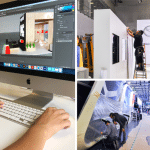
The concept becomes a 3D visual proposal, so you can see exactly what the stand will look like before a single piece is manufactured. Alongside the render, we prepare a video that lets you experience what your visitors will feel as they walk through the space.
For a team that will not see the stand until the day before the show opens, this is the most important phase. It is the moment to move the counter, change a finish or enlarge the storage room, because any change on a render costs far less than a change in the workshop. We work with your comments at every stage so the stand reflects your brand identity accurately.
5. Design approval and technical drawings
Once the design is approved, the proposal is closed: materials, finishes, lighting, furniture and technical drawings.
If the venue requires technical documentation, this is when it is prepared: organisers set submission deadlines that cannot be missed.
6. Build, graphics production and logistics
With the design approved, we move into production. We manufacture the structural, graphic, decorative and functional elements: structures, signage, furniture, counters, joinery, lighting and AV mounts.
We do it in-house, in our 2,000-square-metre manufacturing centre, with facilities in Barcelona and Madrid that include offices, a workshop and a warehouse, and a team of carpenters, painters and electricians. We use materials from sustainable logging.
Logistics are handled by our own team too: we transport the material to the venue in our trailers so we know everything arrives on time and in good condition. For a foreign exhibitor this means the stand is built and moved inside Spain, and only your products and samples need to travel from your country.
7. On-site assembly, supervision and dismantling
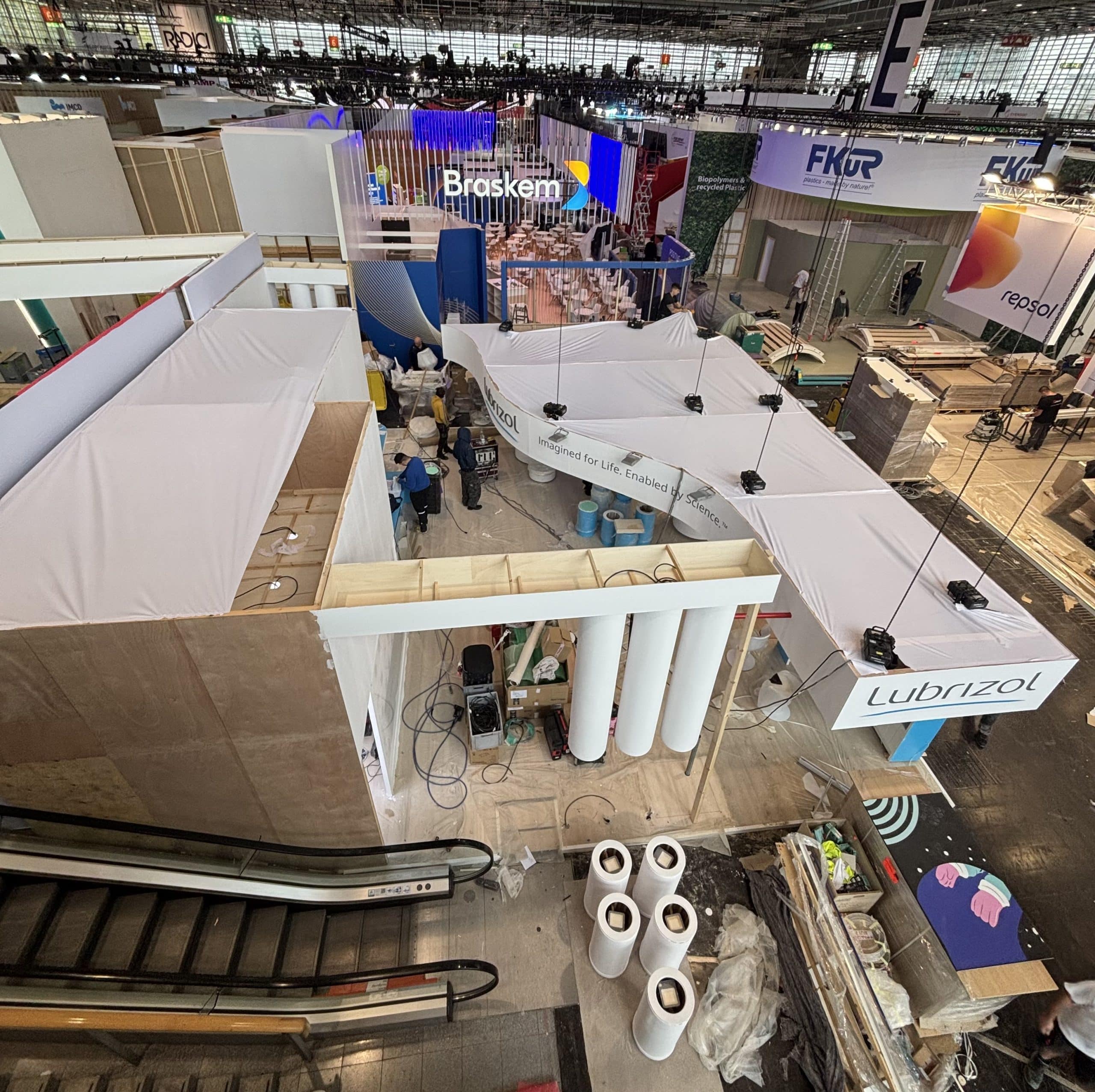
The design process ends in the hall. Our stand assembly in Barcelona team handles the paperwork with the show and installs the stand in the assigned space, coordinating timings, materials and technical work so it is ready before opening.
Before handover we carry out a final check: finishes, visual cleanliness, stability, lighting and overall presentation. When the show closes, we manage dismantling, removal of materials and, where the project allows, storage of reusable elements for future editions.
How far in advance should a foreign exhibitor start?
For stands for international trade fairs, we recommend starting four to six months before the show, especially if the stand needs bespoke design and manufacturing, graphics, lighting or audiovisual equipment. A simpler stand can work with a shorter margin.
If the show is close, we can still study the project: the key is to set priorities and agree on a realistic, technically viable proposal. You can check the trade fairs we work at, from MWC and ISE to Alimentaria, Vitafoods or Fitur, to see the dates coming up.
Common mistakes when designing a stand for a show abroad
- Starting without objectives. Without a clear briefing, the stand may look good but fail to generate business.
- Trying to say everything. Too many messages, screens or products confuse visitors who do not know your brand yet.
- Forgetting the hidden areas. Storage, connections, restocking and a place for the team must be designed in from the start.
- Assuming venue rules are the same as at home. Heights, loads and electrical installations in Spanish venues can force a redesign.
- Requesting changes after sign-off. A change during production costs more time and money than a change on the render.
- Splitting design and build across countries. When an agency abroad designs and a local contractor builds, the result can drift from what was approved.
Your stand in Spain, from design to dismantling
At Factoría Creativa we cover the full exhibition stand design and assembly process: briefing, concept, 3D render, in-house manufacturing, logistics, assembly and dismantling, with a single point of contact throughout. We are an official collaborator of Fira de Barcelona and design custom stands for shows in Barcelona, Madrid and across Europe. You can see real results in our stand projects.
Exhibiting in Spain soon? Tell us about your project and we will prepare a tailored proposal.
Related reading
Frequently asked questions
What are the steps to design an exhibition stand?
Briefing, technical review of the space, creative concept, 3D design, approval and technical drawings, build and logistics, and finally assembly, supervision and dismantling. Each step starts from what was agreed in the previous one, so it pays not to skip any.
Do I need a local stand builder to exhibit in Spain?
It is not mandatory, but it makes things easier. A local contractor knows the venue regulations, handles the paperwork with the organiser, and builds and transports the stand within Spain, so you avoid shipping structures across borders.
What information does a stand builder need to start the design?
The floor plan and dimensions of your space, its location in the hall, your objectives at the show, your audience, an indicative budget and your brand guidelines. It also helps to know which products you will display and which areas you need, such as meeting rooms or storage.
Can I see the stand before it is built?
Yes. We prepare a 3D render and a walk-through video so you can see what the stand will look like and how visitors will experience it. All revisions are made on that proposal before approval and production.
Can you build a stand designed by our agency at home?
Yes. We review the documentation to assess its technical feasibility — dimensions, structure, electrical requirements, graphics and venue conditions — and, if we spot anything that could be improved, suggest adjustments before manufacturing and assembly.
What is the difference between designing a modular and a custom stand?
A modular stand starts from standardised, reusable structures, which are quicker and more budget-friendly. A custom stand is designed from scratch for one brand, one show and specific objectives, with more freedom in shapes, finishes, lighting and visitor experience.