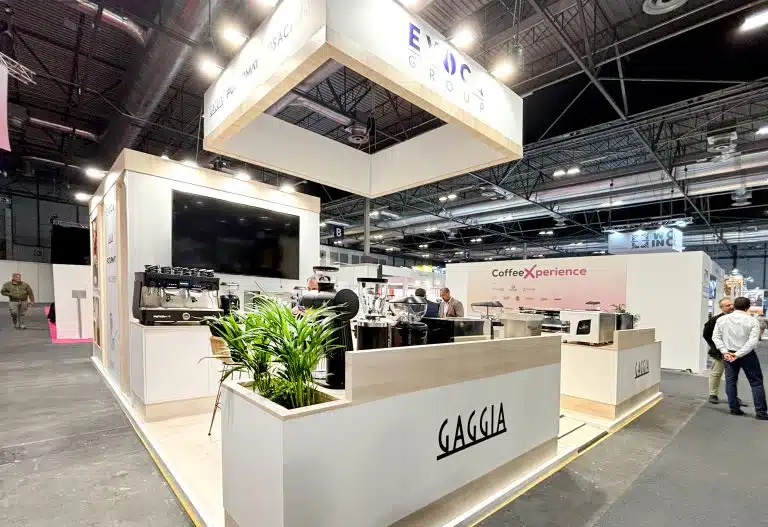
You have booked a small space at a show in Barcelona or Madrid, the hall will be full of large island stands, and your team is flying in from abroad. Good news: the right small exhibition stand ideas can make a 3×3 or 6×3 space perform far above its size. The trick is not fitting more in. It is choosing what matters and removing everything else.
We have been designing, building and installing stands for more than 20 years, at venues such as IFEMA, Fira Barcelona, Fiera Milano, Messe Frankfurt and ExCeL London. Below are the ideas we rely on most, plus the practical points foreign exhibitors tend to discover too late.
Shell scheme or your own stand?
For a small space, most organisers offer a ready-made package: walls, a fascia with your name, basic lighting and a few pieces of furniture. It is the quickest route, but every neighbour gets the same box, so it is hard to be remembered.
The alternative is a stand designed for your brand, either modular (standard, reusable structures) or custom (built for your space and goals). Before deciding, answer three questions:
- What should a visitor remember when they walk away? One idea, not five.
- What do you physically need to show? A product, a demo, a screen, samples.
- What will happen inside? Lead capture, pre-booked meetings, sampling.
Those answers decide the layout far more than the square metres do.
3×3 exhibition stand vs 10×10 booth: same space, different words
If your marketing team is used to US shows, they will talk about a 10×10 booth. In Spain, and in Europe generally, the same space is sold as a 3×3 m stand (9 m²). A 6×3 is roughly a 20×10. Venues and organisers in Spain work in metres, so brief your designer in metres and confirm the exact dimensions, the number of open sides and the maximum height in the organiser’s exhibitor manual.
| Space | Approx. US equivalent | What usually fits |
|---|---|---|
| 3×3 m (9 m²) | 10×10 ft | 1 back wall with graphics, a small counter, 1 high table, 2 staff |
| 4×3 m (12 m²) | 13×10 ft | Counter with storage inside, 1 product plinth, small meeting corner |
| 6×3 m (18 m²) | 20×10 ft | Hidden storeroom, product display, 1 integrated screen, 2–3 staff |
Indicative only: what fits depends on open sides, venue rules and how many people you plan to receive.
Small exhibition stand ideas that actually work
Go vertical
Floor space is limited; height is not, within the venue’s rules. A tall back wall with the logo at the top, a totem or a hanging banner lets people spot you from the aisle, over the heads of the crowd. Height limits and rigging points vary by venue and by stand position, so check them early. For Barcelona, the official Fira Barcelona Technical Regulations set out construction limits, suspended elements and the rule that nothing can invade the aisles.
One message, big type
Visitors give you two or three seconds as they walk past. In that time they read a logo, one line and maybe one image. So:
- Logo high up, readable from the aisle.
- One sentence that says what you do or which problem you solve.
- One strong image instead of several small ones.
- Specs and the full range in a catalogue, a QR code or on screen.
If you are new to the Spanish market, consider a bilingual headline (English plus Spanish) rather than translating every panel.
Light it yourself
Hall lighting is flat. A stand with its own light stands out immediately: spotlights on the hero product, backlit fabric or lightboxes for the main graphic, and warmer light in the conversation area. Lighting also tells people where to look first, without adding another object.

Hide every box
Brochures, samples, coats, suitcases straight from the airport, laptop chargers. If storage is not designed in, it ends up in view. On a small stand, storage is rarely a room; it is built into the design:
- A mini storeroom with a flush door that continues the wall graphic.
- A counter with shelves and lockable cupboards inside.
- Benches or plinths with hollow interiors.
Move the counter out of the doorway
A counter across the front turns into a barrier and leaves visitors outside. Place it on one side or at an angle and keep the entrance clear. A good counter does several jobs: reception point, storage, tablet stand for lead capture and, sometimes, product display.
Design the walk-in
If people have to dodge furniture to enter, they will not enter. Keep the aisle line free, put the main product or message on the wall visible from outside, and use a high table with stools on one side (they take less space than a low table and chairs). With two or three open sides, use them: people come in more easily when they don’t feel trapped.
One integrated screen beats three on stands
A screen set into the wall saves floor space and shows product videos, case studies or demos. Avoid floor stands, which eat space, and plan content that works without sound: you will not hear anything in a busy hall.
Common mistakes on a small stand
| Mistake | Better approach |
|---|---|
| Bringing the whole product range | One hero product, lit; the rest on screen or in the catalogue |
| Four staff on a 3×3 | Two people, in shifts; the team should not take the visitors’ space |
| Walls full of text | One message, large type; details via QR or catalogue |
| Power planned on arrival | Sockets and cable routes defined at design stage and ordered in time |
| Measurements taken from an old floor plan | Confirm exact stand size, open sides and height with the organiser before production |
| No room to meet | High table and stools in a corner instead of a low table and chairs |
What a small stand costs in Spain
It depends on the type of stand, materials, lighting, graphics, furniture and the show itself. As a reference, a basic modular stand can start at around €3,000–6,000. A simple 12 m² modular stand is a very different budget from a premium custom stand at an international show.
For foreign exhibitors, one more line matters: shipping. Working with a builder based in Spain means the stand is produced locally, and reusable elements can be stored between editions instead of being shipped back and forth.
Modular or custom when space is tight?
Modular is fast, keeps costs contained and can be reused across several shows. Custom is designed for your brand and your exact plot, so storage, counter and lighting fit to the centimetre. A custom stand does not need a big footprint: it can be done on a few square metres by prioritising what you really need. If standing out is the goal, have a look at our custom exhibition stands.
Working with a local stand builder in Spain
At Factoría Creativa we handle exhibition stands in Spain end to end: 3D design, production in our 2,000-square-metre manufacturing centre, coordination with the show, installation and dismantling. We are an official collaborator of Fira Barcelona, and for stand build-up at Fira Barcelona we check measurements, venue regulations, electrical needs and storage before anything is built. Exhibiting at IFEMA instead? We also work as an exhibition stand builder in Madrid. You can see the trade fairs we build stands for.
Ideally, get in touch 3–4 months before the show; shorter deadlines are possible depending on the project. Tell us about your show, your square metres and your goals, and we will prepare a proposal.
Related reading
FAQ
How do you make a small exhibition stand stand out?
Use height for your brand, keep to one message in large type and add your own lighting. Keep the entrance clear so people feel invited in, and feature one hero product rather than the full range.
What size is a 10×10 booth in metres?
A 10×10 ft booth is about 3×3 m, or 9 m². In Spain stands are sold in metres, so a 3×3 is the closest equivalent; always confirm the exact plot size with the organiser.
Can I have storage on a 3×3 stand?
Yes. It is usually built into the design: a small storeroom with a flush door in the back wall, or a counter with cupboards inside. That keeps brochures, samples and luggage out of sight.
How many staff should work a small stand?
On 9–12 m², two people are usually enough. With more, the team takes up the space visitors need and the stand looks full even when there are no customers.
Do I need a local stand builder to exhibit in Spain?
It is not mandatory, but it helps. A local builder knows the venue regulations, handles power and build-up schedules on site, and can store reusable parts for your next show, which saves international shipping.
Is a custom stand worth it for a small space?
It can be, especially if you exhibit at several shows or need to be remembered in a crowded hall. Custom design lets you solve storage, counter and lighting for your exact space; modular is the faster, more contained option.