You have booked space at a trade fair in Spain, the organiser sends over the floor plan, and next to your stand number there is a word you may not recognise: lineal, esquina, península or isla. That label matters more than the square metres. It tells you how many sides of your stand face the aisle, and that single fact shapes visibility, access, design and a good part of the budget.
The types of exhibition stands are one of the first things we discuss with every client at Factoría Creativa, where we have spent more than 20 years designing, building and installing stands. Here are the four types, how they translate from Spanish plans, the construction options with indicative prices, and what to plan for when exhibiting in Spain from abroad.
Spanish floor plan terms, translated
The terminology is shared across the European trade fair industry, but British exhibitors usually say stand and American exhibitors say booth. Here is how the Spanish terms you will see at venues such as IFEMA MADRID or Fira Barcelona map to English:
| On the Spanish plan | UK / Europe | US | Open sides |
|---|---|---|---|
| Stand lineal | Inline stand (also row stand) | Inline booth | 1 |
| Stand esquina | Corner stand | Corner booth | 2 |
| Stand península | Peninsula stand | Peninsula booth | 3 |
| Stand isla | Island stand | Island booth | 4 |
The rule of thumb: the more open sides, the more visibility and design freedom, and the more surface you have to get right.
The 4 types of exhibition stands by open sides
Inline stand (1 open side)
The most common format. An inline stand sits in a row between other exhibitors and faces a single aisle. It has three walls: the back wall and two side walls shared with your neighbours.
Everything is seen head-on, so the back wall becomes your main communication surface: message, brand and key product go there. Keep the front open so the interior reads clearly from the aisle.
Corner stand (2 open sides)
A corner stand sits at the end of a row and faces two aisles. You work with two façades and several possible entrances, so you catch traffic coming from both directions.
One tip: do not treat both façades equally. One aisle almost always carries more traffic, and that side deserves your main feature.
Peninsula stand (3 open sides)
A peninsula stand sits at the head of a block of stands. Three sides face the aisle and only one wall is shared, usually with one or two stands that back onto it.
That single wall is an asset. It can house storage, a meeting room or a large-format brand wall, while the three open fronts invite visitors in from several directions.
Island stand (4 open sides)
An island stand is surrounded by aisles on all four sides. It offers the highest visibility and the most freedom: display areas can be arranged around a central element, with several entry points.
The trade-off: no “free” walls. Storage and meeting space have to fit inside the volume without closing the stand off, and every face is on show.
Peninsula booth vs island booth: which should you book?
The difference is one wall, and that wall changes the brief. Here is how all four compare:
| Type | Visibility | Private areas | Best for |
|---|---|---|---|
| Inline | Front only, one aisle | Easy: three walls to build against | First participations, contained budgets, or fairs focused on meeting existing contacts |
| Corner | Medium-high, two aisles | Two walls available | More presence than an inline stand without a big jump in floor space |
| Peninsula | High, three fronts | One back wall for storage, meetings or a brand wall | Established brands that need exposure plus meeting areas |
| Island | Maximum, from the whole hall | Must be built into the volume | Market leaders, launches and large-format stands that want to be a reference point |
Need closed meeting rooms or plenty of storage? A peninsula usually makes better use of the same footprint. Want pure impact from every direction? The island wins, if the design is truly built for four sides.
Venue rules in Spain that affect each stand type
Every Spanish venue has build-up rules, and they affect each stand type differently. For example, the IFEMA MADRID General Rules of Participation (section 25.2) state that:
- Dividing walls between stands must be at least 2.50 m high.
- Rear faces must be finished in a neutral colour, with no logos or lettering.
- Maximum height is 4.00 m, and a single element on the perimeter may rise to 6.00 m, except on walls shared with neighbouring stands.
- An approved project is required before assembly can start.
Each fair can add specific rules, so we always check your event’s exhibitor manual before designing.

Types of exhibition stands by construction: modular, custom and premium
The second classification is about how the stand is built, and it weighs most on the budget. Any of the three works in any position.
Modular exhibition stands
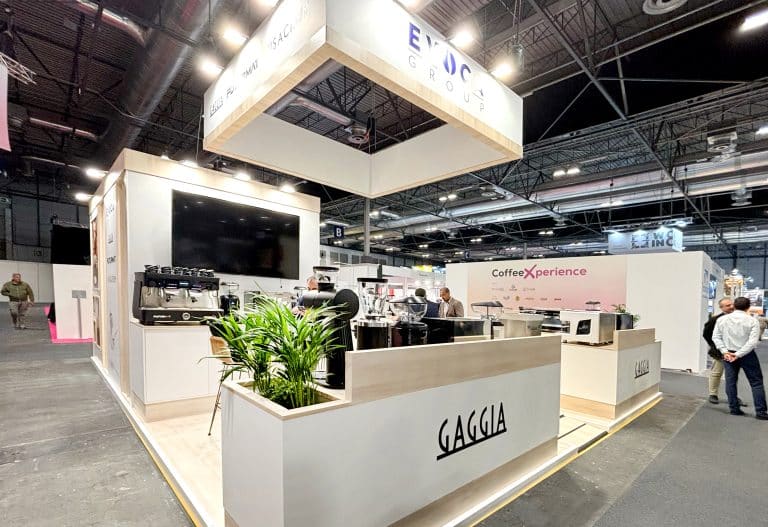
Built from predefined, more standardised structures that can be reused and adapted to different spaces. Assembly is quick and cost is contained, so they suit first participations or tighter budgets. The Arquia Banca stand at Infarma, designed to be versatile for future fairs, and the Evoca Group stand at Guext, built with reusable modular structures, are two examples from our work.
Custom exhibition stands
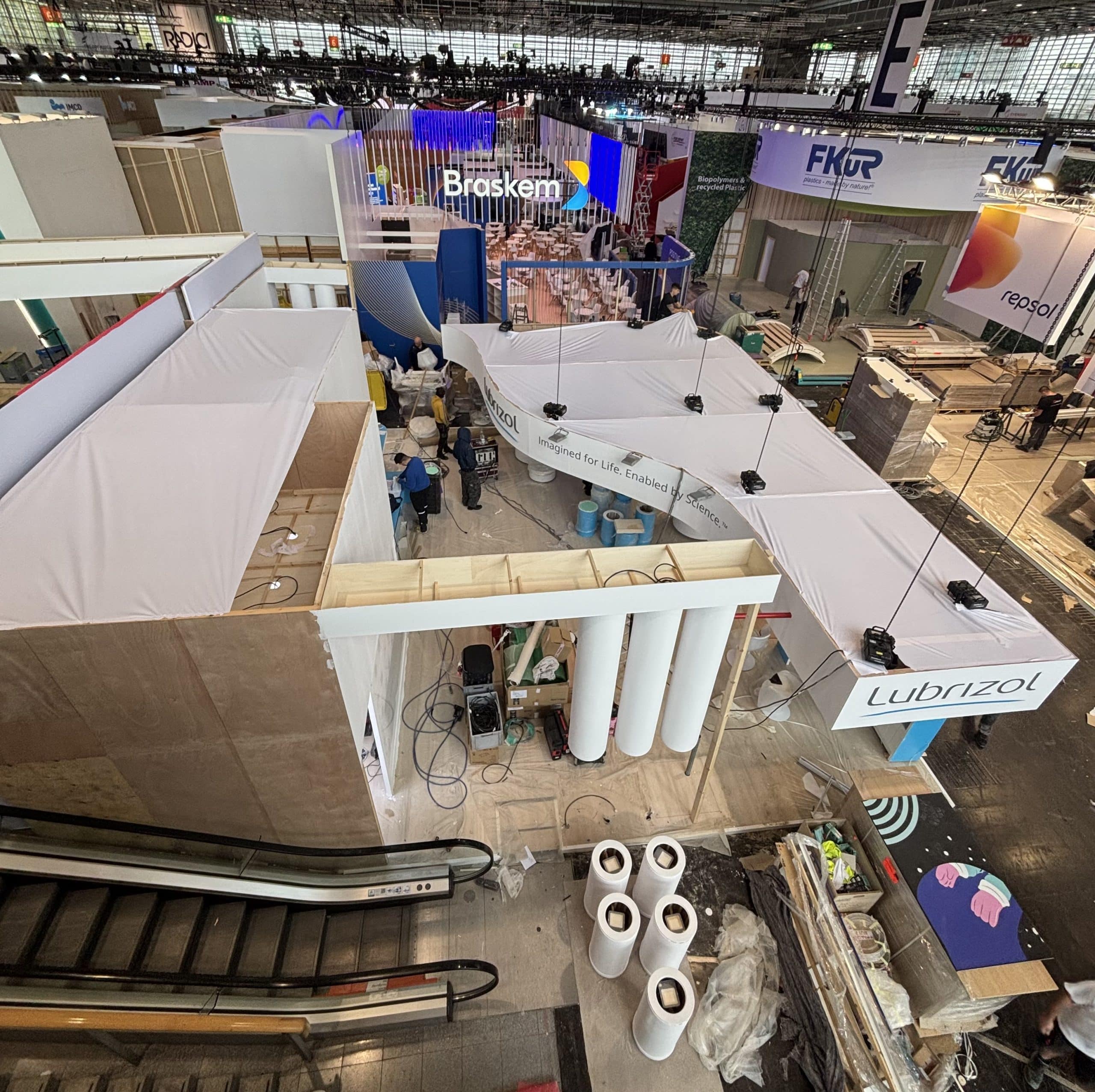
Created from scratch around the company’s identity, objectives, fair and audience, with freedom over shape, layout, finishes, lighting and graphics. The right choice when you want to stand out. You can see examples such as Hausmann and Lubrizol at Vitafoods in our stand projects, and read how we approach custom stands.
Premium stands
A custom stand at the top level: special structures, high-end finishes, decorative lighting and technology.
Indicative prices by construction type
| Construction | Indicative price |
|---|---|
| Basic modular stand | Around €3,000 – €6,000 |
| Medium-sized custom stand | Between €20,000 and €30,000 |
| Premium stand for major international fairs | Can exceed €100,000 |
Real cost depends on size, customisation, materials, the fair and country, assembly, audiovisuals, furniture and logistics. We build both modular and fully custom stands, and the final price also depends on the city where the stand is built.
Exhibiting in Spain from abroad: how to choose your stand type
There is no best type of stand, only the one that fits your goals. Before you confirm your space, answer these questions:
- What do you want to achieve? Generating new leads calls for visibility (corner, peninsula, island). Meeting clients you have already booked can work well on an inline stand with a good meeting area.
- How many zones do you need? Display, demo, meetings, storage. The more zones, the more floor space and the more useful walls you need.
- Who handles things on site? Working with a builder based in Spain means local knowledge of the venue, the rules and the paperwork with the organiser. Our international stands team works with companies arriving from other countries.
- How much lead time do you have? Ideally, start 3 to 4 months before the fair to design, build and install with room to spare. If you are short on time, we can also work to tighter deadlines.
Common mistakes when choosing between stand types
- Designing an island like an inline stand. Putting all your messaging on one front and leaving three blank walls wastes the position you paid for.
- Ignoring the venue rules. Heights, dividing walls and suspended elements have limits; missing them means reworking the project, and without an approved project there is no assembly.
- Reusing a design from another country without checking. A stand built for a fair elsewhere may not meet the rules of a Spanish venue as it is.
- Choosing on price alone. A modular stand can be enough for a first fair, but if the goal is to stand out, a custom stand usually delivers a better return.
How we work at Factoría Creativa
At Factoría Creativa we provide end-to-end exhibition stand design and build: from 3D design to handover, including coordination with the fair, manufacturing in our own workshops in Barcelona and Madrid, assembly and dismantling. Our stand assembly in Barcelona team works at venues such as Fira Barcelona Gran Via and Montjuïc, and we also handle stand design in Madrid and projects in cities such as Dubai or São Paulo. We adapt every project to the position you are given, whether inline, corner, peninsula or island.
Already have your floor plan? Tell us about your project and we will help you get the most out of your space.
Related reading
Frequently asked questions
What are the different types of exhibition stands?
By position in the hall there are four: inline (1 open side), corner (2), peninsula (3) and island (4). By construction, stands are modular, custom or premium.
What is an island booth at a trade show?
An island booth, or island stand, is open on all four sides and surrounded by aisles. It has the highest visibility in the hall, but no shared walls, so storage and meeting areas must be designed into the stand itself.
What is the difference between a peninsula booth and an island booth?
A peninsula has three open sides and one wall shared with other stands; an island has all four sides open. The peninsula’s wall is useful for storage, meetings or a large brand image, while on an island everything has to work without supporting walls.
Can a modular stand be an island or corner stand?
Yes. Construction and position are separate choices: a modular, custom or premium stand can be installed in any type of space. What changes is how the elements are arranged to make the most of the open sides.
How far in advance should I order a stand for a fair in Spain?
Ideally, start 3 to 4 months before the fair, so there is time for 3D design, manufacturing and installation. That said, we also work to tighter deadlines depending on the project.