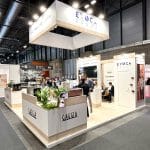
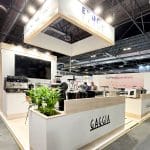
A coffee exhibition stand has to do something most stands never attempt: let visitors taste the product while the sales team talks business a few metres away. At GUEXT 2024 in IFEMA Madrid, Factoría Creativa designed and built a 52.5 m² stand for Evoca Group that did exactly that, combining a working tasting bar, live machine demonstrations, a meeting room and certified sustainable materials. This case study explains the decisions behind it.
If you are looking for our service page for this show, see exhibition stand design for GUEXT Madrid. For the project photos and technical sheet, see the Evoca stand project page. Here we focus on how the stand was thought through, and what other hospitality and coffee brands can take from it.

The brief: a coffee exhibition stand built around the product
Evoca Group makes professional coffee machines and vending solutions. At a hospitality show like GUEXT, its buyers are hotel groups, restaurant chains, distributors and operators who want to see the machines working and taste the result. The objective was simple to state and harder to execute: show the quality and technology of the machines in action, and create the right setting to turn interest into meetings.
That meant the stand had three jobs at once:
- Attract visitors from the aisle with a clear, warm image and the aroma of fresh coffee.
- Demonstrate the machines in real use, with baristas and product specialists on hand.
- Convert conversations into qualified meetings in a private, comfortable space.
A fully custom 52.5 m² layout
The stand was designed and built entirely to measure. Every element, from the counters to the meeting room, was drawn for this space and produced in our Barcelona workshop before being transported to Madrid. Lighting and materials did much of the work: warm, even light on the product, natural timber textures and a layout open enough for visitors to step in without feeling they were interrupting.
A custom build was the right choice here because the stand had to integrate equipment with specific needs: water supply, drainage, power for several machines, storage for cups and consumables, and counters at the right height for both baristas and visitors. Those requirements are much easier to solve when the structure is designed around them rather than adapted afterwards. If you are weighing up the options, our guide to how a custom exhibition stand changes results goes into more detail.
Tasting areas and live demonstrations
The core of the stand was a tasting and live demonstration zone. Visitors did not just watch: they tried the coffee, saw the machines prepare different drinks and could ask the specialists technical questions on the spot.
This matters at a trade fair because a demonstration answers questions a brochure cannot. How fast is the machine at peak service? How consistent is the result? How easy is it to clean? Seeing the product working builds trust in a way that is hard to fake, and it gives the sales team a natural opening for a conversation.
Evoca’s baristas and experts did more than serve coffee. They explained the technical features of each machine, shared tips on getting the best results in professional and home settings, and answered questions one to one. For many visitors that personal attention was what made the visit worthwhile.

What this means for the design
Live demonstrations change the brief for a stand builder. On a coffee or food stand you need to plan for:
- Water connection and drainage ordered from the venue, positioned so they can be reached under the counter.
- Enough electrical capacity for several machines running at once, plus lighting and screens.
- Back-of-counter storage for cups, milk, beans and cleaning materials, out of sight but within reach.
- Durable, easy-to-clean worktops and flooring around the bar.
- Circulation that lets a small queue form without blocking the entrance to the stand.
A meeting room for real business
Alongside the open areas, the stand included a spacious meeting room. This is where Evoca’s team met prospects, partners and distributors privately to discuss specific needs and commercial terms.
The balance between open and closed space is one of the most important decisions on any stand at a B2B show. An open stand attracts footfall; a meeting room protects the conversations that actually close deals. On the Evoca stand the two were clearly separated, so the energy of the tasting bar never disturbed the meetings.
Sustainability built into the materials
Sustainability was a central part of the brief, not an afterthought. Every material used in the design and build carried environmental certification. In practice that meant:
- FSC-certified timber, sourced from responsibly managed forests (Forest Stewardship Council).
- Low-impact paint, free of the most harmful components.
- Reusable, modular structures that reduce waste and can be used again at future events.
- Low-consumption LED lighting to reduce the stand’s energy use during the show.

For a coffee brand, this was also a matter of consistency. Hospitality buyers increasingly ask suppliers about environmental practice, and a stand that visibly uses certified materials supports that conversation. If you want to apply the same approach to your own stand, read our guide to sustainable exhibition stands.
Lessons for hospitality and coffee exhibitors
Whether you exhibit at GUEXT, HIP or a food show such as Alimentaria, the Evoca stand offers a few practical takeaways:
- Design around the product ritual. If people should taste it, the tasting bar is the heart of the plan, not a corner.
- Solve services early. Water, drainage and power have to be ordered from the venue and drawn into the plans submitted for approval.
- Separate energy and privacy. Keep the busy demonstration area and the meeting room apart.
- Make sustainability tangible. Certified materials and reusable structures are easier to explain than abstract claims.
- Start early. Ideally 3–4 months before the show, so design, approval and production are not rushed.
The same show also saw another of our projects: the Supreminox stand at GUEXT 2024, which turned a stand into a working cocktail bar and buffet.
Exhibiting at IFEMA Madrid from abroad
GUEXT is held at IFEMA Madrid. Although our workshop is in Barcelona, we regularly build in Madrid: we produce the stand in our workshop, transport it, and our own crew handles build-up and dismantling within the venue’s schedules. For international exhibitors we act as a single English-speaking contact and invoice as a Spanish company. More about how we work in the capital on our stand design in Madrid page, and a video of the finished stand is available on YouTube.
Frequently asked questions
How big was Evoca’s stand at GUEXT 2024?
The stand measured 52.5 m². It was designed and built entirely to measure by Factoría Creativa in our Barcelona workshop and installed by our own crew at IFEMA Madrid.
How do you design a coffee exhibition stand that works?
Start from the product ritual. Visitors should be able to see, smell and taste the coffee, so a working tasting bar and live machine demonstrations come first. Then add a quieter meeting room for distributors and buyers, storage for consumables and a technical plan for water, drainage and power that the venue approves in advance.
Can a stand with live coffee machines be built sustainably?
Yes. On the Evoca stand all materials carried environmental certification, the timber was FSC-certified, the paint was low-impact and part of the structure was reusable and modular. Lighting was low-consumption LED. Water and power for the machines are ordered from the venue like any other service.
What does a stand like this cost?
A mid-size custom stand of this kind usually falls in the €20,000–30,000 range, depending on finishes, services and AV. Floor space is paid separately to the organiser. A basic modular stand starts from €3,000–6,000.
When should we start planning a stand for GUEXT or another IFEMA show?
Ideally 3–4 months before the show. That leaves time for the concept, plan approval by the venue, workshop production and transport to Madrid. Tighter deadlines are possible, but they limit design and material choices.
Do you work with foreign exhibitors at IFEMA Madrid?
Yes. We work as a single English-speaking contact for international exhibitors: design, production in our workshop, transport to Madrid, build-up, dismantling and storage, with one invoice from a Spanish company.
Planning a stand for GUEXT or another hospitality show?
Tell us about your product, your objectives and the show you are attending, and we will come back with an initial concept and a quote. Call +34 933 17 17 71, email factoriacreativa@factoriacreativa.net or contact us here.