Exhibiting at a trade fair is a serious investment, and its return depends on how well your brand attracts, receives and engages visitors. A custom exhibition stand is one of the most effective tools for that: it increases visibility, starts better sales conversations and makes your brand easier to remember once the show is over.
The difference is not just that a bespoke stand looks better. Its architecture, layout, lighting, materials and technology are designed around your objectives, instead of forcing your brand into a generic box. That lets it catch the eye from the aisle, explain your value proposition more clearly, make meetings easier, guide the visitor’s route and leave a memory that lasts beyond the hall.
At Factoría Creativa we design, build and install custom stands for trade fairs and corporate events in Spain and across Europe, managing each project from the first concept to dismantling. This guide explains where a custom stand earns its cost, when a modular one is enough, and how to measure the result.
What a custom exhibition stand really is
A custom (bespoke) exhibition stand is a space designed specifically for one company, its goals, its visual identity and the conditions of a particular fair. Unlike a standard modular stand, which starts from a predefined structure, a custom design lets you decide from the outset how the space should work. That can affect:
- Layout and circulation
- Heights and overhead elements
- Entrances and open sides
- Reception and hospitality areas
- Meeting rooms
- Counters
- Product display
- Lighting
- Materials and finishes
- Audiovisual elements
- Graphics
- Storage
But customising does not mean adding more. It means every decision has a function. An exhibitor showing machinery needs very different circulation from one that wants private meetings. A brand launching a product may need a demonstration zone, while a company focused on lead generation may need an open, easy-to-walk space. So design should start by understanding what you need to achieve at the fair.
Custom vs modular: where a standard stand falls short
Modular systems are a perfectly good choice for some participations, especially when you need a basic presence or when budget and time are tight. They do have limits, though. The available structure dictates dimensions, materials, layout and often how the brand is presented. As a result, very different companies can end up with stands that look alike, and in a hall with hundreds of exhibitors that lack of differentiation costs attention.
| Modular stand | Custom exhibition stand | |
|---|---|---|
| Typical budget | From €3,000–6,000 for a basic stand | €20,000–30,000 for a mid-size stand; premium stands at major international fairs can exceed €100,000 |
| Brand expression | Mainly through graphics | Architecture, materials, light and layout all express the brand |
| Layout | Limited by the system | Designed around your goals and visitor flow |
| Reuse | High, easy to reconfigure | Possible if planned: reusable core with show-specific elements |
| Lead time | Shorter | Ideally start 3–4 months before the show |
Space rental is always paid separately to the organiser. Many of our clients take a hybrid route: a reusable core built to measure, plus graphics and features adapted to each fair. That keeps the brand recognisable at several shows a year while spreading the investment. For a fuller breakdown, see our guide to exhibition stand costs in Spain.
A custom project works on that first impression. Architecture can create a recognisable silhouette, open the stand towards the busiest aisles or add an element visible from across the hall. It is not about being different for its own sake, but about a difference that makes sense for the brand.
Job one: make the visitor stop
Before any conversation can happen, the stand has to win attention. Visitors are bombarded with structures, screens, products, lighting, messages and people at the same time, so a custom stand has to communicate fast. From a distance, a visitor should be able to tell:
- Who the company is
- What kind of solution it offers
- What makes the offer different
- Why it is worth walking over
Architecture organises this information through volumes, lighting, visual hierarchy and open space. Sometimes an overhead element identifies the brand from several aisles; sometimes a demonstration visible from outside works much better. At Vitafoods Europe 2025 in Fira Barcelona, for example, the 4-metre-high light cannon we built for Lubrizol Life Science became one of the most photographed points of the show, while a backlit suspended cylinder carried the logo to every corner of the hall. The right answer depends on the company and on how its audience behaves.
Design starts from a commercial objective
One of the most common mistakes is to start with aesthetics. Before choosing colours or materials, define what should happen inside the stand. A company may exhibit to:
- Generate leads
- Present or launch a product
- Meet existing clients
- Find distributors
- Strengthen its market position
- Enter a new market
- Run demonstrations
- Create content
- Hold strategic meetings
Each objective calls for a different layout. If meetings are the priority, you may need semi-private zones or enclosed rooms. If you want traffic, the space should remove barriers and invite people in. If you are presenting a technical product, the demonstration can become the centre of the visit. A custom stand works best when sales strategy is translated directly into spatial decisions.
How layout shapes visitor behaviour

Layout determines how people enter, what they see first and where they go next. A stand can look great and still be awkward to walk through. A counter placed too close to the entrance acts as a barrier; a badly placed meeting area creates constant noise; a key product placed at the back goes unnoticed.
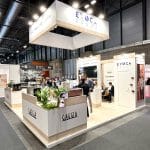
Design has to study routes. On stands open on several sides, work out which aisles will bring the most people. Decide which elements need immediate exposure and which can be discovered once inside. A good layout lets visitors understand the space without instructions. The stand we built for SIRIO at Vitafoods, shown above, uses an overhead ring to mark the brand while keeping the floor open for meetings and product display.
Turning brand identity into architecture
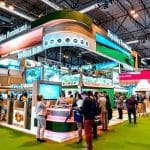
Customisation means your brand no longer depends on a logo printed on a wall. Colours, materials, lighting, geometry and furniture can express identity in a much deeper way. A technology company might use clean lines, integrated lighting and digital elements. A brand linked to sustainability might work with natural materials, planting or reusable systems; at Vitafoods 2025, our stand of almost 200 m² for Hausmann Aromatic used a tree-like central structure, FSC-certified wood, suspended greenery and natural fabrics to tell the story of its botanical ingredients. A premium brand might choose restrained compositions, high-quality materials and carefully designed hospitality areas.
Avoid generic decoration. The stand should feel like a physical extension of the brand. We explore this further in our article on visual branding on exhibition stands.
Lighting: much more than illumination
Lighting can completely change how a stand is perceived. Even, uniform light lets people see the space, but a more considered strategy also creates hierarchy: it highlights products, enhances materials, separates zones and directs attention. A product display may need focused light, while a meeting area needs something softer and warmer. Screens and video walls must be coordinated with the rest of the lighting to avoid glare and visual competition. On a custom stand, lighting is designed together with the architecture, not added afterwards.
Technology where it adds value

Screens, interactive interfaces, augmented reality and AI-based tools can increase how much a stand interacts with visitors. But adding technology simply because it is eye-catching does not guarantee better results. It needs a concrete job, for example to:
- Explain processes that are hard to show physically
- Let visitors explore a large catalogue
- Personalise content
- Capture information
- Run demonstrations
- Create participative experiences
Our article on AI at trade shows explains how these tools can generate interaction and improve the visitor experience. Technology works best when it is part of the stand’s overall strategy.
Better conversations, not just more footfall
The impact of a fair is not measured only by how many people walk past. The quality of the conversations matters just as much. A well-planned design supports different levels of interaction: an open zone for first contacts, tables for more detailed discussions and private rooms for strategic meetings. That lets the sales team adapt the space to each visitor. Someone who wants a quick look at a product does not need the same experience as a client who has booked an hour-long meeting. Designing these situations in advance makes the stand work much better during the show.
Put the product at the centre of the plan
If you show physical products, their position should be part of the concept from the start. A frequent mistake is to design the stand first and decide afterwards where the products go. It should be the other way round. The product can be the visual hero, a demonstration piece or a conversation starter, and its height, lighting, accessibility and relationship with other elements change how it is perceived. Small products may need showcases, integrated lighting or bespoke supports. With machinery or large equipment, the challenge is to organise the route around the product without blocking access.
Plan storage and day-to-day operations
A stand also has to work from the inside. For several days, the team needs somewhere to keep documents, personal belongings, merchandise, drinks, sales material and products. If storage is not planned, all of this ends up in view and damages the image of the stand. A custom stand can integrate storage rooms, cupboards and back-of-house areas discreetly, along with power points, device charging, a coffee point and restocking space. These details rarely appear in the most spectacular renders, but they have a huge impact on daily operations.
Design for photos, video and social media
Fairs generate more and more content. Marketing teams, clients, visitors and press photograph and film stands, so it is worth thinking about how yours will look on camera. A recognisable visual element can become the backdrop for interviews, photos and social posts. Still, the stand should not become a set designed only for Instagram. The in-person experience comes first; the ideal is a stand that works for visitors and also produces images that extend its reach beyond the venue.
How a custom stand strengthens brand recall

By the end of a fair, a visitor may have walked past dozens of stands. Memory is selective: people are more likely to remember spaces that offered a clear, different or particularly relevant experience. That memory might attach to a distinctive structure, a demonstration, a conversation or a particular way of presenting the product. The impact does not end when the visitor leaves. A consistent design helps them recognise your company later, when they receive a sales email, visit your website or see you on social media. The stand becomes one piece of a wider brand strategy.
Custom stands and lead capture
A purpose-designed space also makes lead capture smoother. Registration can use tablets, forms, QR codes or systems connected to your CRM, but the tool is only part of it. You also need to decide when to ask for details. Asking before you have created interest can feel pushy; asking after a demonstration or a good conversation feels natural. The layout can support this: an interactive zone can end at a registration point, and a demonstration can lead into a sales area. Lead capture works best as part of the route, not as an isolated desk. Remember that visitor data collected in the EU is subject to the GDPR, so consent wording should be ready before the show.
Build-up is part of the project
A render shows how the stand should look; execution decides how it actually looks. Production, transport, coordination with the venue and installation must all follow the design. Fairs have strict schedules, technical regulations and their own procedures, and they may require drawings, certificates or prior approvals. Working with one company that handles the whole process means you do not have to coordinate several suppliers yourself. We manage projects from initial design through workshop production, technical paperwork, build-up and dismantling, with one project manager who speaks your language.
Venue regulations also shape the design
Every exhibition centre sets its own technical, safety, build-up and space-use rules. Before producing a custom stand, check requirements such as maximum heights, permitted loads, approved materials, electrical installations and technical documentation. Organisers such as Fira Barcelona publish specific information for exhibitors and contractors, which allows each project to be planned precisely and avoids last-minute changes. A good design is not only attractive and practical; it also has to be buildable within the real conditions of the fair.
How to measure whether your stand worked
Success should not be judged only by whether people “liked” the stand. Define your indicators before the fair:
| Objective | Possible indicators |
|---|---|
| Capture contacts | Number and quality of leads |
| Generate meetings | Meetings held and opportunities opened |
| Present a product | Demonstrations and interactions |
| Raise awareness | Visits, mentions and content generated |
| Strengthen relationships | Clients hosted and strategic meetings |
| Create content | Photos, videos and reach after the show |
This data shows which elements worked and what to adjust next time. A custom stand is even more valuable when it is part of a process of continuous improvement.
Mistakes that reduce the impact of a custom stand
Customising does not automatically mean designing well. The most frequent mistakes we see are:
- Trying to say too many things at once, when visitors need to grasp the offer quickly
- Filling the space with screens, structures or furniture without a clear hierarchy
- Entrances that are hard to see
- Counters that block the aisle or the entrance
- Too few places to sit down and talk
- Not enough storage
Good design balances impact and functionality.
Frequently asked questions about custom exhibition stands
What is a custom exhibition stand?
A stand designed specifically for one company, with architecture, layout, materials, lighting and communication adapted to its brand and to its objectives at a particular fair.
What is the difference between a custom and a modular stand?
A modular stand starts from predefined structures and configurations. A custom stand gives far more freedom to adapt the space to your identity, your sales goals and the conditions of the fair. Hybrid solutions combine a reusable core with bespoke elements.
Do you need a large space for a custom stand?
No. Custom stands also work on small plots. What matters is using the available space well and prioritising the elements you really need.
How much does a custom exhibition stand cost?
It depends on size, design, materials, technology, furniture, logistics and build-up conditions. As a guide, a mid-size custom stand costs €20,000–30,000 and premium stands for major international fairs can exceed €100,000, while a basic modular stand starts from €3,000–6,000. The space is paid separately to the organiser, and every project is quoted individually.
Can a custom stand be reused?
Yes. Elements can be designed to adapt to different fairs and plot sizes, keeping a recognisable identity and spreading the investment. We can store them in our Barcelona workshop between shows.
How long before the fair should the project start?
Ideally 3–4 months before the show, to allow time for design, approvals, production and technical coordination with the organiser. Urgent projects are possible with less notice.
Does Factoría Creativa work outside Barcelona?
Yes. We build stands at IFEMA Madrid and other Spanish venues, and at European exhibition centres such as Paris, Cologne, Düsseldorf, Frankfurt, Milan and Lisbon, with our own installation crew.
A stand designed to multiply opportunities
A trade fair concentrates a huge number of potential contacts, conversations and opportunities into a few days, and your stand shapes how many of them happen. A generic space fulfils the basic role of being present. A custom exhibition stand uses architecture, communication and experience to strengthen your brand and support your sales goals: it gets the right people to stop, understand your offer, come in, interact and find a reason to continue the relationship after the show.
If you are preparing your next participation, contact Factoría Creativa or call +34 933 17 17 71. Tell us the fair, the dates, the size of your stand and your main goals, and we will start working on a proposal for your custom stand.