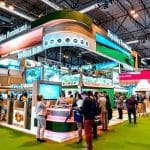
AI at trade shows is no longer a novelty reserved for tech giants. Virtual assistants, smart screens, real-time content and visitor analytics are now realistic options for any exhibitor who wants more interaction on the stand, better-qualified leads and useful data after the show. The key is to treat AI as part of the stand design, not as a gadget added at the end.
More and more companies want to stand out through the experience they offer, and AI is being built into exhibition stands to attract visitors, increase engagement and generate higher-quality business opportunities. At Factoría Creativa we design, build and install stands where technology, design and strategy work together, including at technology events such as MWC Barcelona and ISE at Fira Barcelona Gran Via.
What is an AI stand?
An “AI stand” is an exhibition stand that uses artificial intelligence to interact with visitors, personalise what they see and give the exhibitor useful information. In practice that means tools such as conversational assistants, smart screens, recommendation systems and analytics, integrated into the architecture of the stand.
Trade fairs have changed. Visitors no longer just want information about a product; they expect to interact with brands and get answers tailored to them. A traditional stand relies on visual elements and face-to-face sales. A stand that uses AI well can add experiences that adapt to each visitor, while the sales team focuses on the conversations that matter.
Why AI at trade shows attracts more visitors
Winning attention is one of the hardest things at a fair. Visitors are exposed to hundreds of visual stimuli and decide in seconds whether to approach a stand. AI makes the experience more dynamic through:
- Interactive virtual assistants
- Smart screens
- Digital avatars
- Immersive experiences
- Personalised content
- Automatic recommendations
These tools put the visitor at the centre and tend to increase dwell time. The shift is simple: before, visitors received information passively. Now they can interact, get personalised answers, see demonstrations adapted to their interests and take part in immersive experiences.

The main benefits
- More footfall: interactive elements spark curiosity and help you stand out from neighbouring stands.
- Personalised experiences: content adapts to each visitor’s profile or interests.
- Smarter lead capture: automated systems collect commercial information and make follow-up easier.
- More interaction: conversational tools answer questions and show information instantly, in several languages.
- Behaviour insights: anonymised data on routes, interests and the busiest zones of the stand.
- Brand differentiation: well-executed innovation reinforces the image of a modern, technology-driven company.
AI technologies you can build into a stand
Chatbots and virtual assistants
They answer visitors’ questions in real time and give personalised information, which is especially useful at busy moments when the team is tied up in meetings. Multilingual assistants are valuable at international fairs, where visitors arrive from dozens of countries.
Digital avatars
AI-driven avatars interact with visitors by voice or text. They work best as a guide to the product range or as a host that directs people to the right specialist, not as a replacement for your staff.
Smart screens
Screens that adapt the content shown according to different variables: time of day, the profile a visitor selects, or the product they are standing next to.
Real-time content generation
AI can create personalised messages, images or product configurations during the event, giving visitors something to take away. We also produce AI-generated videos for stand screens and pre-show campaigns.
Data analytics
Analytics tools help you understand visitor behaviour and improve future commercial actions, for example which demos drew the most interest or which questions came up most often.
Building AI into the stand: screens, power, network and sightlines
The technology only works if the stand is designed for it. That means deciding, at the drawing stage:
- Where screens and touch points go: height, viewing distance and how many people can gather in front without blocking the aisle.
- Power and cabling: enough circuits, hidden cable routes and access for technicians during the show.
- Connectivity: do not rely on shared venue Wi-Fi at a busy fair. Order a dedicated wired connection or line from the venue well in advance.
- Acoustics: voice assistants struggle in noisy halls. Consider directional microphones, headsets or text-first interfaces.
- Lighting: screens and lighting must be coordinated to avoid glare and reflections.
When these decisions are made with the architecture, the technology looks like part of the stand rather than equipment parked on it.
Design still matters more than the technology
However valuable the technology, the success of a stand still depends on its design. AI complements design; it does not replace it. A well-designed stand:
- Increases brand visibility
- Attracts more visitors
- Makes sales meetings easier
- Improves the visitor experience
- Increases brand recall
- Generates more business opportunities
Every technology solution should therefore sit within an overall design and communication strategy. If you are weighing up a bespoke build, see how a custom exhibition stand multiplies your impact.
What an attractive trade show booth needs, with or without AI

We design every project around the brand’s visual identity, visitor flow and the exhibitor’s commercial goals. Each one is different, but the stands that perform best share some elements.
Clear visual identity
Visitors must see immediately who you are: a visible logo, corporate colours, clear messages and consistent graphics across the whole space. More on this in our guide to visual branding on exhibition stands.
Functional layout

The layout should make it easy for visitors to circulate, for sales conversations to happen, for products to be presented and for demonstrations to run. A spectacular design loses effectiveness if it gets in the way of interaction.
Strategic lighting
Lighting is one of the most underrated tools in stand design. It highlights products, creates atmosphere, guides attention and improves the perception of the space, and it is essential when screens are involved.
Meeting spaces
Many business opportunities are created on the stand itself, so include meeting tables, private areas, networking space and somewhere to sit down.
Where you will see AI on stands
AI-powered stands are now common at the world’s major technology events, such as MWC Barcelona and CES, and increasingly at sector fairs in pharma, food and industry. Brands use these tools to present products, create immersive experiences and gather information about visitors. In Barcelona, the calendar of technology events at Fira Barcelona Gran Via includes MWC, ISE and Smart City Expo World Congress, where we have built stands for clients such as Tech Data and Iquall Networks, a network automation company, at MWC.
GDPR and visitor data at EU trade shows
If your stand collects data, European rules apply, whoever the exhibitor is. A few practical points:
- Consent and transparency: under the GDPR, tell visitors what data you collect, why and for how long, and get valid consent where needed (for example, for marketing follow-up).
- Biometrics: facial recognition and other biometric identification involve special-category data. Avoid them, or take specialist legal advice and obtain explicit consent.
- People counting: anonymised sensors that count footfall or measure dwell time are a far safer choice than cameras that identify individuals.
- AI transparency: make it clear when visitors are talking to an AI assistant rather than a person, in line with the EU AI Act’s transparency obligations.
- Data processors: if a supplier runs the AI tool, make sure there is a data processing agreement and that you know where the data is stored.
This is general guidance, not legal advice; your data protection officer should review the set-up before the show.
Common mistakes with AI trade show stands
Many companies make mistakes that reduce the effectiveness of their participation. The most common:
| Mistake | Consequence |
|---|---|
| Technology first, design second | Screens and devices that look bolted on |
| Too much information | Visitors get confused and walk on |
| Poor lighting | Low visibility and glare on screens |
| No meeting space | Fewer sales opportunities |
| Weak connectivity | Demos that fail at the busiest moment |
| Poor circulation | Crowds blocking the stand and the aisle |
| No data plan | Leads that never reach the CRM, or GDPR risks |
How we approach technology stands
The success of a technology stand starts long before build-up. Our process covers:
- Concept design
- 3D renders
- Planning of interactive experiences with your technology partners
- Integration of screens and AV systems into the structure
- Coordination of power, network and venue services
- Production in our 2,000 m² Barcelona workshop and on-site installation
With over 20 years of experience, we have built stands for companies exhibiting at national and international events. You can see real examples on our technology exhibition stands page and in our stand projects.
Cost: when AI on the stand is worth it
The cost depends on the technologies you choose. Simple, affordable options include an AI assistant on a tablet or a smart screen running adaptive content. More advanced developments, such as custom avatars or behaviour analytics, need more budget and lead time. AI is worth it when it solves a real problem: explaining a complex product, qualifying leads while the team is busy, or serving visitors in several languages. If it is just there to look modern, invest in design, lighting and a better meeting area instead.
Future trends
AI will keep changing trade fairs over the coming years. The most promising trends include hyper-realistic avatars, real-time machine translation, advanced content personalisation, predictive analytics and hybrid experiences combining physical and virtual spaces. Companies that adopt these solutions thoughtfully will find it easier to offer attractive experiences and stand out.
Frequently asked questions about AI at trade shows
What is an AI stand?
An exhibition stand that uses artificial intelligence tools, such as assistants, smart screens or analytics, to interact with visitors and personalise their experience.
What advantages does it offer over a traditional stand?
More interaction, better lead capture, personalised experiences, multilingual support and a greater ability to attract visitors, provided the technology is integrated into a good design.
Is it expensive to add AI to a stand?
Not necessarily. There are affordable solutions, such as AI assistants or smart screens, as well as more advanced developments like custom avatars or behaviour analytics. Budget depends on the tools chosen and how much bespoke content they need.
Which types of companies use AI at trade fairs?
More and more sectors do, especially technology, industrial, pharmaceutical, automotive and advanced services companies that want to differentiate themselves and offer innovative experiences.
Can AI be added to an existing stand?
Yes. Many solutions can be added to modular or custom stands that have already been designed, without a complete redesign, as long as power, connectivity and screen positions are planned.
Do GDPR rules apply to data collected on the stand?
Yes. Any personal data collected from visitors at a fair in the EU is covered by the GDPR. Be transparent, collect only what you need, obtain consent for marketing and avoid biometric identification unless you have specialist legal advice.
AI at trade shows: the future is already on the show floor
Used well, AI is a new way to connect with visitors, create memorable experiences and increase your brand’s impact at fairs and events. Combined with good design, it turns a traditional stand into a powerful tool for marketing and generating business opportunities.
If you are preparing your next fair and need a stand built around your brand and your technology, contact Factoría Creativa or call +34 933 17 17 71 for tailored advice.