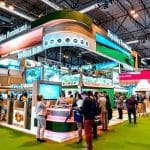
Knowing what visitors look for at a trade show is the starting point for every effective exhibition stand. Trade visitors arrive with limited time and a long list of stands to see. In practice they look for four things: a reason to stop, clear information, something to experience and people worth talking to. This guide explains each one and how to design for it, based on more than 20 years of building stands at Fira Barcelona, IFEMA Madrid and venues across Europe.

What visitors look for at a trade show in the first few seconds
Walk down any aisle at MWC, Alimentaria or FITUR and you will see the same behaviour. Visitors scan, filter and move on. Most of them already know which exhibitors they want to meet, and the rest of their time is spent spotting anything new or relevant in a few seconds per stand.
That has a clear consequence for design: your stand must answer three questions almost instantly. Who are you? What do you offer? Is it relevant to me? If the answers are not obvious from the aisle, even a beautiful stand will be walked past. The rest of this article explains what helps visitors answer yes.
1. An interactive experience
Beyond the design, build and installation of the stand itself, the experience you offer is what keeps visitors on the stand for longer. Visitors increasingly want to examine, hold and try things, not just look at them.
Live demonstrations
Live demonstrations are one of the most effective ways to engage visitors and show what your company offers first hand. A few principles make them work:
- Schedule them. Fixed times, announced on the stand and before the show, build a small audience and help your team plan.
- Make visitors part of it. Touching, tasting or operating the product makes the message far more memorable.
- Tell a story. Explain what problem the product solves and how it changes the visitor’s work or business.
- Keep it clear. Short explanations, supported by graphics or video, so non-specialists can follow.
A good example is the coffee tasting bar and live machine demonstrations we built for Evoca at GUEXT 2024, or the working cocktail bar and buffet on the Supreminox stand.
Touchscreens and digital content
Touchscreens give visitors a hands-on, self-guided experience, which suits people who prefer to browse before talking to anyone. They work best for:
- Interactive digital catalogues, where visitors explore products, specifications and configuration options.
- On-demand explainer videos, so each visitor chooses the topics that interest them.
- Lead capture, letting visitors request information or a follow-up call directly from the screen.
Screens must be built into the architecture of the stand, with power and sightlines planned from the start, rather than added as an afterthought. Our article on AI and technology at trade show stands covers this in more detail.

Shareable spaces
A dedicated photo spot can amplify your presence beyond the show floor. A creative, on-brand backdrop, a clear event hashtag and a small incentive for sharing (a draw, a sample or an exclusive offer) encourage visitors to post. Phone charging points nearby are always welcome, and give people a reason to stay a few minutes longer. On a B2B stand, keep this feature compact: it should support your objectives, not compete with meeting space.
2. Places to talk and network
Many visitors come to a trade fair primarily to meet people: suppliers, partners and peers. A stand that makes conversation easy has a real advantage. When we design networking areas we think about:
- Informal encounters: high tables or a small bar where conversations can start spontaneously.
- Professional meetings: seated areas or a closed meeting room for detailed discussions.
- Fast exchange of information: QR codes and digital lead capture so contact details are recorded accurately.
- The right proportions: the balance between open display and meeting space depends on your objectives and should be decided in the brief.

3. Clear, concise information
In a noisy, crowded hall, clarity wins. Visitors do not have time to decode complicated messages. This is how to make your information work:
Choose your key messages
Before the show, define the two or three things you most want visitors to remember. Everything on the stand, from the main headline to the screen content, should support them.
Let visuals do the work
Use images, graphics and product displays that communicate at a glance. Large blocks of text on walls are rarely read at a trade show.
Short, direct copy
When you use text, keep it short and focused on benefits. Avoid jargon unless your audience is purely technical, and remember that at international shows many visitors read English as a second language.
A clear hierarchy
Put the most important message where everyone sees it: high on the stand, readable from the aisle. Secondary information belongs at eye level and in conversations, brochures or digital content.
Listen during the show
Collect feedback from visitors through quick surveys, conversations and the questions people ask most. Adjusting your pitch during the show, and noting what to change for next time, makes each edition more effective.

4. An attractive, professional stand
Design is still the first filter. A visually strong trade show booth, like the Tech Data stand we built for MWC, attracts attention in a sea of options and communicates the identity and values of a company instantly. The first visual impression often decides whether a visitor stops or walks on.
What makes a stand attractive in practice?
- Brand consistency: colours, materials and graphics that are recognisably yours.
- Height and visibility: elements that can be seen across the hall, within the venue’s height limits.
- Lighting: planned from the beginning to highlight products and create atmosphere.
- Quality materials and finishes: visitors notice the details, and they associate them with the quality of your product.
- Function as well as form: an open layout, storage, meeting space and circulation that make the stand easy to use.
For a deeper look at each element, read our exhibition stand design tips and our guide to visual branding on exhibition stands.

5. The human factor
At a trade fair, the people on your stand are as important as the stand itself. A well-informed, approachable team turns a visit into a relationship. What visitors look for in your team:
- A personal connection: a welcoming attitude that invites them to explore and ask questions.
- Relevant information: accurate, detailed answers about the products and services on show.
- Confidence: willingness to explain clearly and follow up builds trust in the brand.
- Personal attention: understanding each visitor’s needs and adapting the conversation to them.
Practical tips: brief the team before the show on key messages and how to qualify leads, schedule shifts so there is always someone available, keep the stand tidy throughout the day and, at international shows, make sure the languages your visitors speak are covered.

Putting it together: design the visitor journey
The best stands treat these elements as a journey rather than a checklist:
- From the aisle: brand and key message visible at a distance.
- At the edge of the stand: an open, unintimidating entrance and something to look at or try.
- On the stand: a demonstration, product display or screen that explains the offer.
- In conversation: a team ready to help and a space to sit down.
- Leaving: a simple way to share contact details and a clear next step.
When we design a stand, this journey is drawn into the layout from the first sketch. If you are about to start, our exhibition stand planning checklist explains when each decision should be made, and our custom stands page shows how we work.
Frequently asked questions
What do visitors look for first at a trade show stand?
Usually the brand and what it does. In the few seconds they spend walking past, visitors scan for a recognisable name, a clear statement of what you offer and a sign that the stand is relevant to them. That is why a short headline and a visible logo at height matter more than detailed text.
How long do you have to catch a visitor’s attention?
Only a few seconds as people walk down the aisle. Your stand needs to communicate who you are and why it matters from a distance, then give visitors an easy, unintimidating way to step in.
Do live demonstrations really work at trade fairs?
Yes, when they are short, scheduled and relevant. Demonstrations let visitors see, touch or try the product, which helps them remember it and gives your team a natural way to start a conversation. Publish the times on the stand and in your pre-show communications.
Are social media corners and photo walls worth it on a B2B stand?
They can be, if they are on-brand and do not take space from meetings. A well-designed backdrop with the show hashtag gives visitors a reason to share and extends your reach, but it is a secondary feature, not the core of the stand.
How important is the stand team compared with the design?
Equally important. Design brings people in, but informed, approachable staff turn visits into conversations and leads. Brief the team on key messages, the products on show and how to qualify visitors, and schedule shifts so the stand is never left unattended.
How do we design a stand around what visitors want?
Start from your objectives and your visitor profile, then plan the stand as a journey: visibility from the aisle, a clear message, something to try, a place to talk and a simple way to leave contact details. A stand builder can turn that journey into a layout, ideally 3–4 months before the show.
Design your stand around your visitors
We design, build and install custom exhibition stands in Barcelona, Madrid and across Europe, with our own workshop and build-up crew. Call +34 933 17 17 71, email factoriacreativa@factoriacreativa.net or request a quote.