The FITUR 2027 dates are set: Wednesday 20 to Sunday 24 January 2027 at IFEMA Madrid. Three trade-only days, then a weekend open to the public. If your destination, hotel group or airline is exhibiting, that leaves roughly ten weeks from today to design, build, ship and install a stand. We build stands at IFEMA every season, and this guide covers what an international exhibitor needs to know: the official schedule, how the five days change the way your stand should work, and a realistic timeline from where we are now.
FITUR 2027 dates, opening hours and venue
According to the official FITUR website at IFEMA, the 47th International Tourism Trade Fair takes place at IFEMA MADRID (Av. del Partenón 5, 28042 Madrid), close to Madrid-Barajas airport. This edition grows by two additional halls.
| Day | Opening hours | Who gets in |
|---|---|---|
| Wednesday 20 January 2027 | 10:00 – 19:00 | Trade visitors only |
| Thursday 21 January 2027 | 10:00 – 19:00 | Trade visitors only |
| Friday 22 January 2027 | 10:00 – 19:00 | Trade visitors only |
| Saturday 23 January 2027 | 10:00 – 20:00 | Trade and general public |
| Sunday 24 January 2027 | 10:00 – 18:00 | Trade and general public |
Build-up and breakdown days are set by IFEMA in the exhibitor documentation.
Puerto Rico is the FITUR 2027 partner
IFEMA has named Puerto Rico as FITUR 2027 partner, which puts the Caribbean and the Americas firmly in the spotlight this year. IFEMA also cites more than 10,000 exhibitors, 155,000 trade participants, 100,000 members of the public and 161 countries. The detailed activity programme has not been published yet.
Why FITUR’s format shapes your stand
FITUR is really two shows in one. From Wednesday to Friday your visitors are buyers: tour operators, travel agencies, hotel and airline partners, tourism boards. They arrive with pre-booked meetings and want somewhere to sit down and talk business. On Saturday and Sunday the halls fill with Madrid’s travelling public, in far greater numbers, looking to discover destinations, try something and take something home.
A well-planned FITUR stand handles both audiences without being rebuilt halfway through the week:
- Meeting area shielded from the aisle for the trade days, ideally bookable by slot.
- Open, experiential front (screens, tastings, simulators, virtual reality) to absorb weekend footfall.
- Reception counter that sorts visitors quickly: who has a meeting and who has come for information.
- Storage big enough for five days of brochures in several languages, giveaways and catering supplies.

Exhibiting at FITUR from abroad: what changes
Most of the 161 countries at FITUR plan their stand from outside Spain. That raises three practical questions.
Local stand builder or your usual contractor?
Flying a team and a stand in from abroad means freight, crew travel and hotels during build-up, and a crew that may not know IFEMA’s procedures. A Spain-based exhibition stand builder with a workshop close to Madrid removes most of that: the stand is manufactured locally, delivered by road and installed by people who work at IFEMA regularly. Many international exhibitors combine both: their agency or HQ sets the creative brief, and a local partner turns it into a buildable project.
Shipping and storage
If you are shipping your own products, AV kit or merchandise, plan the delivery window early. Exhibitors from outside the EU should also check the customs clearance information IFEMA publishes for exhibitors before anything leaves the country.
Language works the other way round
For an overseas brand, the usual mistake is not “Spanish only” but “English only”. FITUR is where you meet the Spanish travel trade and the Spanish public, and Spanish is also the working language of most Latin American buyers. Spanish-language materials and at least one Spanish speaker on the stand make a visible difference, especially on the weekend.
What we have learned building stands at FITUR
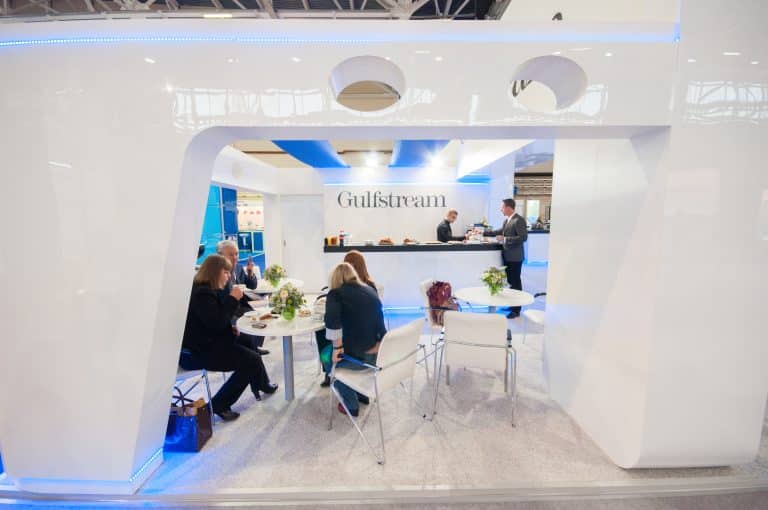
One example from our stand projects is the Gulfstream Aerospace stand at FITUR. The brief was to convey the brand’s innovation and technology through its best-known aircraft. We placed scale models on lightweight structures with a high-gloss white melamine finish that brought light into the space. The stand was large, and the key was the layout: open, interactive areas where visitors tried flight simulators, without losing the space for client meetings.
Four lessons repeat themselves from one edition to the next:
- Brand fit beats square metres. The best stand tells the same story as the brand. If you sell sustainable travel, the stand should look it: natural materials, efficient lighting, no single-use plastics.
- Experience over brochures. Destinations from every continent compete with ambitious sets. Visitors remember what they did: a simulator, a tasting, an immersive film.
- Hospitality and people. A spectacular stand loses impact with an unprepared team. Brief your staff, cover the languages and decide who handles meetings and who works the aisle.
- Location and flow. Spaces near entrances or themed areas get more traffic. Wherever you are, the design should draw people in from the main aisle, never wall it off.
| Element | Stand that gets walked past | Stand that works at FITUR |
|---|---|---|
| Concept | Generic, loosely tied to the brand | A clear idea of the destination or company |
| Engagement | Brochures and one screen | Simulators, tastings, immersive content |
| Layout | All open or all closed | Protected meeting area plus open public front |
| Languages | One language only | English, Spanish and target-market languages |
| Outcome | Passing traffic | Meetings held and qualified leads |
FITUR 2027 stand timeline: from November to January
Ideally you start 3 to 4 months before the show, which allows time for the concept, 3D design review, unhurried manufacturing and coordination with IFEMA. For FITUR 2027 that meant September or October. If you are starting in November you can still make it, but decisions need to be quick: we work to tighter deadlines, though every lost week narrows the choice of finishes and the room for changes.
| When | What to do |
|---|---|
| Now (November) | Confirm brief, space and location; appoint your stand design and build partner |
| November – early December | Creative concept, 3D design and budget sign-off |
| December – early January | Workshop manufacturing, graphics, AV, IFEMA paperwork; book meetings with buyers |
| Days before 20 January | Transport and build-up at IFEMA Madrid |
| During the show | Meetings Wednesday to Friday; consumer activity at the weekend |
| After 24 January | Breakdown and lead follow-up |
Remember that Spain slows down over Christmas and the 6 January holiday (Epiphany): build that into your sign-off dates.
How much does a stand at FITUR cost?
It depends on space, design, materials, technology and logistics. As a general guide for trade fairs in Spain:
- Basic modular stand: around €3,000 – €6,000.
- Mid-sized custom stand: between €20,000 and €30,000.
- Premium stand for major international shows: can exceed €100,000.
At FITUR, where destinations compete with large themed sets, most exhibitors choose custom exhibition stands rather than shell scheme.

Common FITUR mistakes to avoid
- Starting late. The most common mistake and the most expensive: improvised solutions and no room for changes.
- Arriving without a meeting plan. At FITUR business is not left to passing traffic; meetings are booked before the show.
- Looks over function. A beautiful stand with no meeting space or storage becomes awkward by day two.
- Ignoring the before and after. Social media, newsletters and press releases beforehand; lead follow-up afterwards. Without both, much of the investment is lost.
How Factoría Creativa handles a FITUR stand
Factoría Creativa has more than 20 years of experience designing, manufacturing and assembling trade fair stands, with offices, a workshop and a warehouse in Barcelona and Madrid and our own carpenters, painters and electricians. For FITUR we take care of the whole project: creative concept, 3D design, manufacturing, logistics and transport, assembly and dismantling at IFEMA Madrid, and technical coordination with the organisers. That is how we work on international exhibition stands for companies coming to Spain. See our FITUR exhibition stand design service, or learn more about our stand design in Madrid, and tell us about your project for a tailored quote.
FITUR opens a busy winter calendar: check the other trade fairs we work at this season. And if Madrid is on your agenda for January, start now: ten weeks go quickly when there is a stand to build.
Related reading
Frequently asked questions
When is FITUR 2027?
FITUR 2027 runs from 20 to 24 January 2027 at IFEMA Madrid. The first three days (20–22 January, 10:00–19:00) are for trade visitors only; on 23 and 24 January the fair also opens to the general public. Check the official IFEMA website for any changes.
Is FITUR open to the public?
Yes, at the weekend: Saturday 23 January (10:00–20:00) and Sunday 24 January (10:00–18:00). Wednesday to Friday is reserved for trade visitors.
Who is the FITUR 2027 partner country?
Puerto Rico is the FITUR 2027 partner, as announced by IFEMA on the official fair website.
Can a foreign company hire a local stand builder in Madrid?
Yes, and it is common. A Spain-based contractor manufactures the stand locally, knows IFEMA’s procedures and avoids international freight and crew travel. Your team or agency can keep control of the creative brief while the local partner handles design development, build and installation.
How far in advance should I book a stand for FITUR?
Ideally 3 to 4 months ahead, to allow for design, manufacturing and IFEMA paperwork. Shorter lead times are possible, but decisions must be quick and there is less room for changes and special finishes.
What languages should my FITUR stand use?
English is essential given the international audience, and Spanish is just as important: FITUR draws the Spanish travel trade, Spanish-speaking buyers from Latin America and, at the weekend, the Spanish public. Add the languages of any other markets you want to attract.